
Home » Assisted Living Activities for Seniors » Sit-down games for senior citizens
Hovi Care’s care units organize meaningful activities for its clients every day. One of the most popular and easy to organize pastimes are various games played while sitting at a table.
Sit down games are an excellent way to bring joy, stimulation, and shared moments to daily family life. They are particularly suitable for people whose mobility is limited or at times of the day when quieter activities are suitable. Easy sit down games are a very safe and comfortable way to support cognitive activity.
Sit down games provide an opportunity for interaction, which is important for social well-being. Playing together encourages conversation, laughter, and a sense of achievement. Many seated games support memory, concentration, and reaction skills, and they can usually be adapted to different levels of functional ability. Participation is also possible in the role of listener or observer.
At their best, sit down games bring rhythm to the day and offer meaningful activities without pressure. They help maintain functional capacity and motor skills, hand-eye coordination, social activities and create meaningful moments.
Next we will introduce few games which we have found to work well. We will also share some tips for organizing a fun game session.
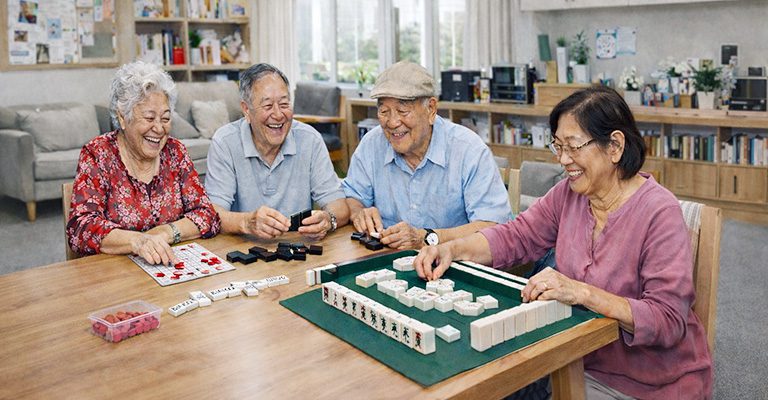
Many traditional games which are familiar to seniors are also well suited to seated play and can be easily adapted to different levels of functional ability:
Many of the above-mentioned games can be played either in a group or in pairs, and it is also possible to participate as a listener. These games also enable intergenerational togetherness, as even grandchildren know how to play them.
The sit down games suitable for people with memory disorders need to be clear, familiar, have a right rhythm, and they should be played in a safe atmosphere.
For people with memory disorders, it is particularly important to choose a space with as few distractions as possible. Turn off the television and reduce background noise. Ensure good lighting and position all participants so that they can see each other and the game equipment easily.
Ensure that the game equipment is ready before the game begins. Advance preparation helps to get off to a smooth start and prevents waiting, which can easily impair concentration and create frustration.
It is important to remember that the game does not have to be competitive. Playing together, calm interaction, and a positive experience are more important than the outcome of the game. Short, calm game sessions are often more enjoyable for people with memory disorders than highly competitive games.
A good game session starts with clear instructions. Choose a game that suits the participants’ abilities and explain the rules briefly and clearly using simple language. Repeat the instructions if necessary and demonstrate how to play. Taking your time helps everyone to keep up.
The advantage of organizing activities at home is that you already know the participants and their preferences.
Alertness levels may vary from day to day and even during the same day, so pay special attention to the right time of day for the game session. Some snacks might also help to keep the spirits up.
The instructor’s role is to be encouraging and flexible. It is important to pay attention to the participants’ energy levels and adapt the game if necessary for example by shortening the playing time or simplifying the rules. Praise, humor, and a warm presence create a safe atmosphere where everyone can participate in their own way.
Play on other people’s terms. Remember that not everyone needs to understand the rules perfectly or even play by them completely. Often participation is more important than playing by the rules.